
Skid Steer Snow Blowers in Southern Alberta
Foothills Equipment carries skid steer snow blowers in 48, 60, 72 and 84 inch, from TMG Industrial. We are in Calgary and Lethbridge, serving Southern Alberta, everything south of Red Deer. A blower does the one thing a pusher and a blade cannot: it puts the snow somewhere else. Over the bank, over the fence, off the edge of the lane, out of a lot that has run out of room to pile.
This is a one line category and we would rather be straight about that. Of the five attachment lines we carry, only TMG builds a snow blower. Three of the others are fabricators who build no powered rotating tools at all. What we put against a narrow range is an advisor who will size it to your machine properly, which is where most of the regret in this category comes from anyway. If you are clearing open lots with room to pile, look at snow pushers and blades first.
One snow blower line from TMG Industrial, in four widths.
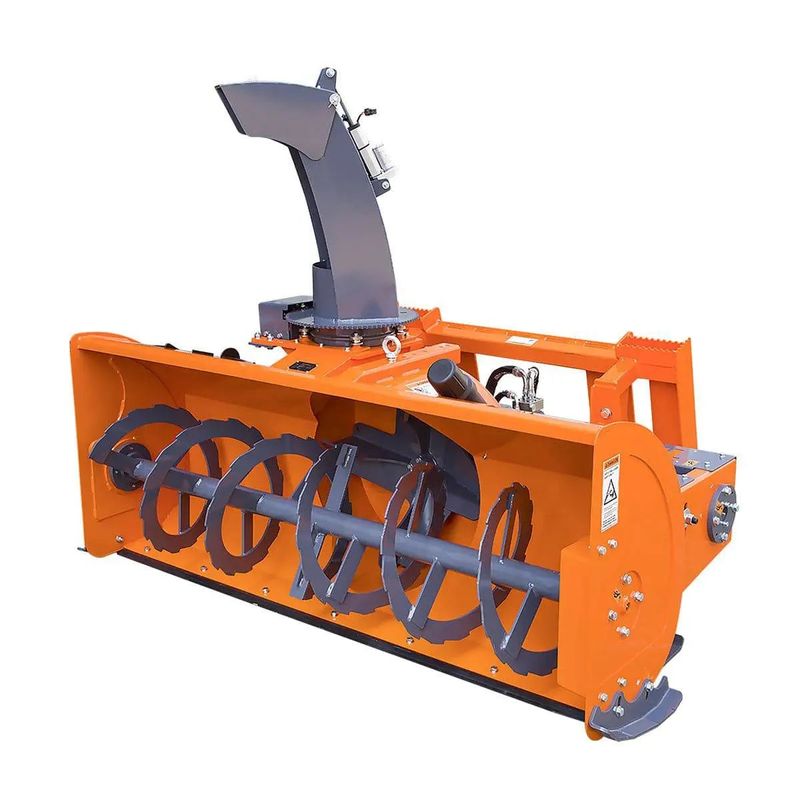
TMG Skid Steer Snow Blower
Talk to an Advisor →
No snow blowers match those filters.
Clear a filter to see the rest, or tell an advisor what machine you run and we will find the right one.
A pusher moves snow. A blower gets rid of it.
A snow pusher is a box. It carries a full windrow to the pile with nothing spilling off the ends, and on a big open lot with somewhere to stack it, nothing clears faster. A blade casts snow off to one side as you drive, which is what you want on lanes, driveways and roads. Both of them move the snow, which means both of them need somewhere for the snow to go.
A blower throws it clear. It chews the snow up and fires it out a chute, as far as you aim it, and the pile never has to be touched again. That is worth paying for in five situations.
The lot has run out of room
By February a lot that has been pushed all winter has banks nobody can stack any higher. A blower cuts those banks down and throws the snow behind them, instead of you paying a truck to haul it away.
There is nowhere to pile at all
Tight commercial lots, condo and townhouse complexes, school and church yards, anywhere a pile costs you parking stalls the client wants back.
Narrow runs
Lanes, alleys, sidewalks, pathways and long driveways with a fence or a ditch on both sides. There is no room to windrow, so the snow has to go up and over.
Drifts and packed snow
Wind is the Alberta problem more than snowfall is. A pusher rides up on a hard drift. A serrated auger cuts into it.
Acreages and yard sites
Long driveways where pushing snow to the end just builds a wall at the road.
When a pusher is still the better buy: big open lots with a pile spot, short runs, and any operation where speed per pass matters more than where the snow ends up. A lot of contractors end up running both, a pusher for the big lots and a blower for the tight sites and the February cleanup.
The machine picks the width, not the property.
A blower asks more of a machine than a blade does, because it is not just pushing, it is driving an auger and an impeller while the machine drives forward. Too much blower on too small a machine means it bogs down in the heavy stuff, which is exactly when you need it. Too little blower on a big machine is a slow night.
| Width | Carrier | Impeller |
|---|---|---|
| 48 inch | 20 to 40 HP mini loader | 20 inch |
| 60 inch | 25 to 55 HP skid steer | 24 inch |
| 72 inch | 45 to 75 HP skid steer | 24 inch |
| 84 inch | 45 to 75 HP skid steer | 24 inch |
Two things to read out of that table. The 48 inch is a mini machine tool, not a small version of the others, and it runs a mini loader mount pattern rather than the standard skid steer plate, so tell us which mini machine you run. And the 84 inch runs on the same horsepower band as the 72 inch, so on a machine in that range the wider unit is the one that clears more per pass, as long as your gates, lanes and pathways can take the width. Measure the narrowest thing you have to fit through before you pick the width.
For scale, the 72 inch ships at about 1,170 lb, so this is a real attachment on the front of the machine and the carrier has to handle it loaded.
Standard flow turns it, and the chute is why you buy this one.
Hydraulic flow
The drive motor takes up to 75 L/min, which is 20 GPM, continuously, at 3000 PSI. That matters more than it sounds: it means most standard flow skid steers can turn it, so you are not forced into a high flow machine to own one. Continuously is the key word, though. Unlike a blade, which only draws oil when you angle it, a blower is pulling flow the whole time it is running, and that works the oil and the machine harder over a long night. Tell us your flow rating and we will confirm it against that number.
Mount
The full size units go on a skid steer plate that TMG states is ISO 24410 compliant, which is the standard interface a universal skid steer quick attach uses. The 48 inch mini unit uses a mini loader mount pattern instead, and there is more than one of those in the market, so we ask which mini machine you run rather than assuming.
The chute
It turns a full 360 degrees, driven by a hydraulic motor rather than a cable or a crank, and the deflector adjusts, so the operator changes where the snow lands from the seat while still moving. On a lane with parked cars on one side, or a lot where you are throwing over a bank on one pass and into a yard on the next, that is the feature that decides how many properties get done before daylight. TMG upgraded this to motor driven rotation on the 2024 model.
Skid shoes
They adjust, so you set the blower up off a gravel surface and back down for pavement. On gravel, running too low sends rock through the impeller and out the chute, which is a broken window or a damaged truck on somebody property. Set them before the first snowfall, not during it.
Auger and impeller
A 17-1/2 inch serrated steel auger pulls the snow in and cuts into packed drifts, and the impeller, 24 inch on the full size units, throws it out the chute. TMG states the fan to gearbox connection is splined rather than a flat key, and calls it the more reliable of the two.
Questions we get asked
What size snow blower do I need for my skid steer?
Match it to the machine, then to the narrowest thing you have to drive through. The 60 inch suits 25 to 55 HP machines, and the 72 and 84 inch both want 45 to 75 HP. The 48 inch is built for 20 to 40 HP mini loaders rather than full size skid steers. Give us the make, model and horsepower and we will tell you the width, because an oversized blower on an undersized machine bogs down in exactly the heavy snow you bought it for.
Do I need a high flow machine to run a snow blower?
No. The drive motor takes up to 75 L/min, which is 20 GPM, at 3000 PSI, so most standard flow skid steers can turn it. What is different from a blade is that a blower draws that flow continuously while it works, rather than only when you move something, so it asks more of the machine over a long night. Tell us your flow rating and we will confirm it before you order.
Should I buy a snow blower or a snow pusher?
A pusher if you have open lots and somewhere to stack the snow, because nothing clears a big lot faster. A blower if there is nowhere to pile, if the runs are narrow, or if the banks have got too high to push any more. A blower throws the snow clear instead of moving it to a pile you have to deal with later. Plenty of contractors run both.
Can I run a snow blower on a gravel driveway?
Yes, and this is what the adjustable skid shoes are for. Set them so the blower rides above the gravel rather than scraping it, or you will send rock out the chute. Set them low again for pavement when you want a clean scrape. It takes a few minutes and it is worth doing before the season rather than in the dark.
Will it fit a mini skid steer?
The 48 inch model is built for mini loaders of 20 to 40 HP, with a 20 inch impeller and a mini loader mount pattern rather than the standard skid steer plate. There is more than one mini mount pattern out there, so tell us which machine you run and an advisor will confirm the version before it is ordered.
Sort it out before the first heavy snow.
Tell an advisor the machine, the horsepower and the sites you are responsible for, and we will come back with the width that fits, confirm your hydraulics will turn it, and say straight out if a pusher or a blade would serve you better for less.